I Went to Gstaad to Talk Money
Written by
Victoria Voigt
Content
Jan 26, 2026

The Era of the New Old: Why Nothing Feels New Anymore
Written by
Victoria Voigt
We think we are satisfied until something new comes up. Once we take the opportunity, the satisfaction comes on a quick and short-term basis, and then we chase again. It's not rocket science, but cosmic chemistry.
From a neuroscientific standpoint, this is classic dopamine behavior. The first exposure excites us; the second reassures us; the third barely registers.
Studies in behavioral psychology call this hedonic adaptation (treadmill): our tendency to return to a baseline level of desire regardless of gains.
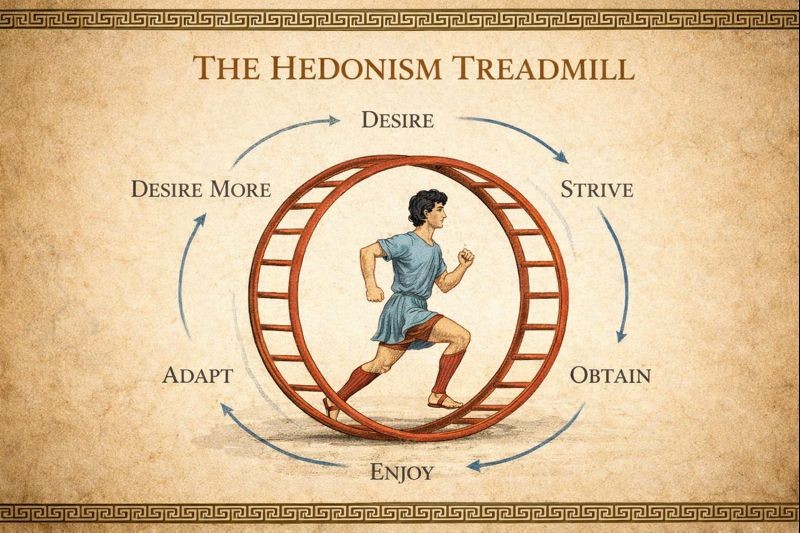
Sources: https://en.wikipedia.org/wiki/Hedonic_treadmill
And so we chase again. Like starved animals, even though our baseline of living and access has never been higher.
What connects the Bible, the Quran, and the Kamasutra?
In earlier eras, “new” was rare. A new tool, a new book, a new idea could define decades.
The Bible, Quran, Kamasutra shaped entire generations and continue to do so.
The Bible is still the most sold book in the world's history, with over 5 billion copies sold across the world, over the centuries.
So, how did they age so well?
Maybe because they weren't written under any pressure, maybe because they were "not for sale".
Markets reward constant reinvention. New technology has made more billionaires in just a few decades than the whole history of humankind through its long, few thousand years of life.
1% dictates the rules of the game, while 99% works for them. No wonder why socialism is going through its rebirth. Balance matters in every aspect of life.
Research shows that when novelty becomes continuous, its emotional impact weakens. The brain adapts faster. It resembles a textbook example of addiction.
Is Big Tech poisoning us with new addictive man-made products? It seems like. But we as consumers are both victims and responsible for it.

Assertiveness is a well-trained skill that is as rare and as hard as thinking and living your own way.
We are not dissatisfied because we want too much. We are, because we can't say no to new things.
We are dissatisfied because newness no longer has time to become meaningful.
Who gives the real meaning and purposefulness to things and people wins on a long and wide scale.
Consider the evolution of the mobile phone. Decades ago, a phone was a long-term companion for the whole household. It was connecting in both offline and online.
It stayed in your daily life for years, accumulating scratches, habits, and familiarity. There was no annual reveal, no countdown, no sense that what you owned had quietly expired overnight.
Now consider the iPhone. Each year, a new version premieres with cinematic precision. Marginal improvements are framed as revolutions. Feels like slow and fast progress at once.
Cameras sharpen, screens stretch, processors accelerate, yet before the device has time to age into meaning, it is rendered psychologically obsolete. Ownership no longer matures into attachment as it is interrupted by anticipation. The phone does not grow old with us. It is replaced before it can.
It's such a powerful cultural shift that it has easily translated into our most intimate relationships. It's not even about how many divorces we have right now, but how many people struggle to choose to have sustainable relationships with real liabilities and commitment.
What once felt like progress now feels like a subscription to impermanence. The phone is always new, and therefore never truly ours.
The answer: Material stuff in today's world will not keep us satisfied.
Slow life is luxury
Look how billionaires keep bragging about it in their interviews, how they don't use their phones, emails, or have old cars, real estate, wives/ husbands. Today, this stands out and is a symbol of mega-luxury. Tranquility of owning and sustaining. Like in real estate: the longer you keep them, the more valuable they become.
The future may not belong to the newest idea, product, or identity, but to the ones that can be lived with slowly. The ones that deepen instead of update.
The ones that feel better the tenth time, not just the first.
Upgrade comes naturally when you show enough care.

In a world obsessed with what’s next, the quiet revolution may be learning how to not quit.
Perhaps the problem was never that nothing feels new anymore.
Perhaps the problem is that we forgot how to let anything become old. Including ourselves.